Wednesday, June 23, 2010

St. Anne's Church
Augsburg, Germany
Photo By:
Architecture: Renaissance

Built in 1321 by Carmelite monks, St. Anne's Church went on play an important role in the history of the Reformation. In 1518 that Martin Luther stayed here with the Carmelite friars when he was in town to meet the papal legate, Cardinal Cajetan, who demanded that Luther submit to the pope. St. Anne's Church converted to Lutheranism in 1545. The Goldsmith's Chapel was added in 1420; the Fugger's Chapel in 1509. The spire was added in 1607 by Elias Holl.
The church was restored and redesigned in the Baroque and Rococo styles between 1747 and 1749.


Santa Maria Presso di San Satiro
Milan, Italy

Photo By: Anthony M
Architecture: Renaissance


First built in 876, the church was dedicated to St. Satyrus, brother of St. Ambrose, and stands on the reputed site of his house. Later the church was dedicated also to Mary, so that the church's full name is now "St. Mary Staying with St. Satyrus."

A very nice and simple structure.

Convento de Cristo
Tomar, Portugal
Photo By:
Architecture: Renaissance
The castle of the Knights Templar of Tomar was built by Gualdim Pais, provincial Master of the Order of the Temple, around 1160. Later that century, the castle was chosen as the headquarters of the Portuguese Templars.
The Tomar castle was built as part of a Templar defense system to secure the border of the Christian kingdom against the Moors of Iberia. According to Christian chroniclers, in 1190 the castle of Tomar resisted the attacks of caliph Abu Yusuf al-Mansur, who had previously taken other Portuguese strongholds to the South. (A plate near the entrance of the nave commemorates the feat.) The round church (rotunda or charola) of the castle of Tomar was built in this early period and is Romanesque in style.


Milan Cathedral
Milan, Italy
Photo By:
Architecture: Gothic

The street plan of Milan, with streets either radiating from the Duomo or circling it, indicates that the Duomo occupied the most important site in the ancient Roman city of Mediolanum.
Saint Ambrose built a new basilica on this site at the beginning of the 5th century, with an adjoining basilica added in 836. When fire damaged both buildings in 1075, they were rebuilt as the Duomo.
In 1386 the archbishop, Antonio da Saluzzo, began the new project in a rayonnant Late Gothic style that is more characteristic of France than Italy. Work proceeded for generations.
The main spire was topped in 1762 with a polychrome statue of the Madonna, to whom the Duomo and its predecessor have always been dedicated.


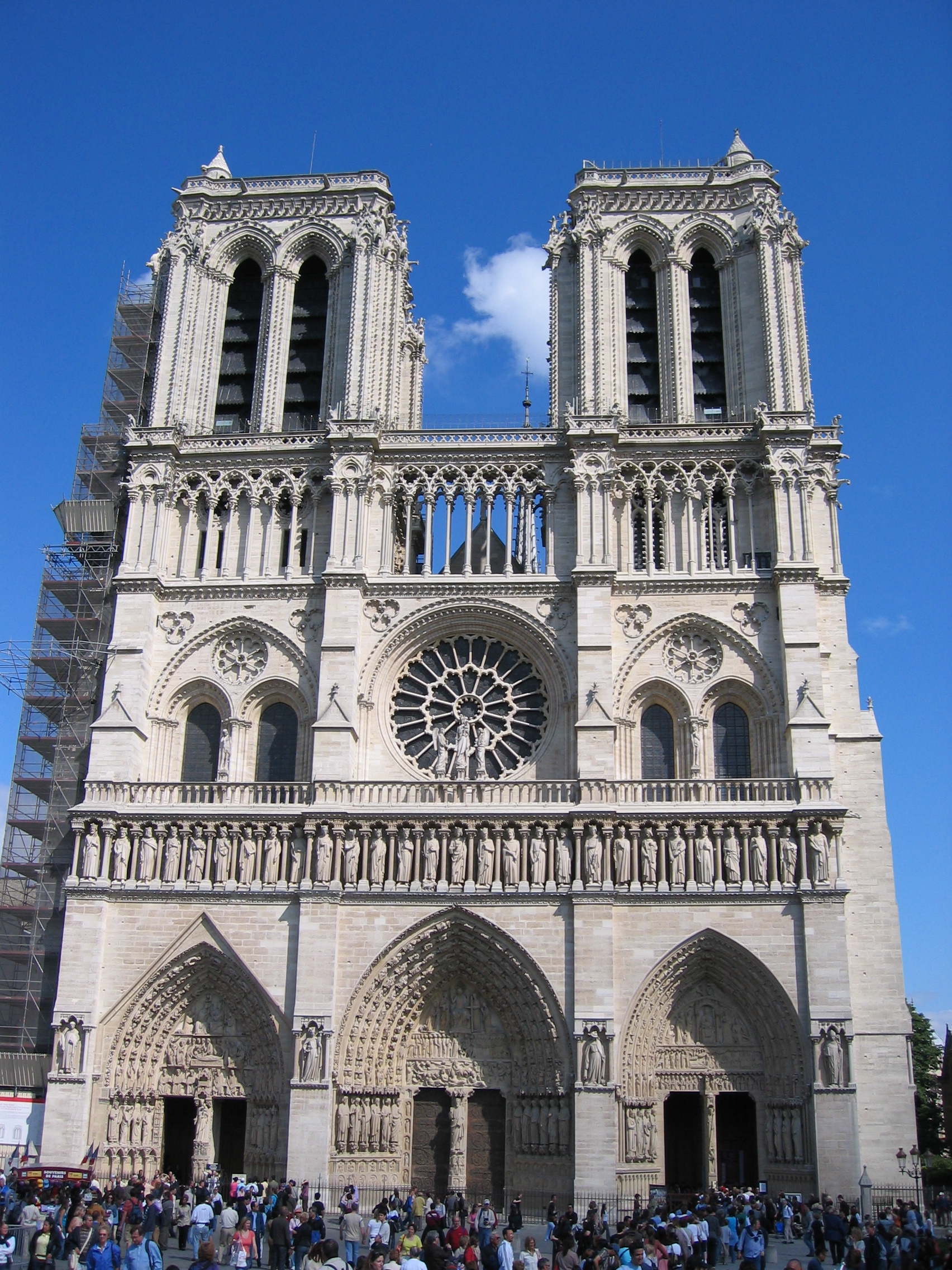
Notre Dame Cathedral
Paris, France
Photo By
Architecture: Gothic
The Notre Dame de Paris stands on the site of Paris' first Christian church, Saint Etienne basilica, which was itself built on the site of a Roman temple to Jupiter.
Notre-Dame's first version was a "magnificent church" built by Childebert I, the king of the Franks at the time, in 528, and was already the cathedral of the city of Paris in the 10th century. However, in 1160, having become the "parish church of the kings of Europe," Bishop Maurice de Sully deemed the building unworthy of its lofty role, and had it demolished.
Construction on the current cathedral began in 1163, during the reign of Louis VII, and opinion differs as to whether Bishop Maurice de Sully or Pope Alexander III laid the foundation stone of the cathedral.
Construction of the west front, with its distinctive two towers, began in around 1200 before the nave had been completed. Over the construction period, numerous architects worked on the site, as is evidenced by the differing styles at different heights of the west front and towers.


Canterbury Cathedral
Canterbury, England
Architecture: Gothic
The history of Canterbury Cathedral begins with St. Augustine, a Roman missionary sent to England by Pope Gregory to convert the heathen Anglo-Saxons. The mission was a success: in 597 AD, Augustine baptized King Ethelbert of Kent.
In 602 AD, Augustine dedicated a cathedral church on this site to Christ the Savior. It was in fact probably an existing church building from Roman times, rehallowed by the missionary saint.
Maria Laach Abbey
Maria Laach, Germany
Photo By:
Architecture: Romanesque
The Abbey of Maria Laach was founded in 1093 by the Count Palatine of the Rhine Heinrich II (d.1095) and his wife Adelheid (1100). They were unable to have children and donated what would have been spent on a dowry on the foundation of a monastery across the lake from their castle. The foundation was accepted and overseen by the Archbishop of Trier and the first monks came from the monastery of St. Maximin near Trier. Built on the west side of the lake now known as the Laacher See, the monastery became known as the Abbatia ad Lacum, "Lake Abbey."